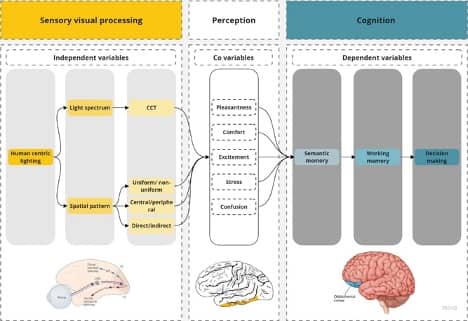
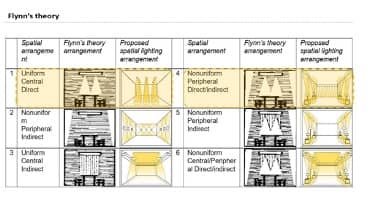
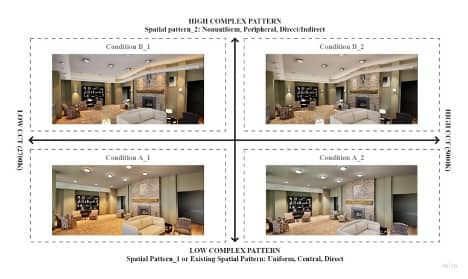
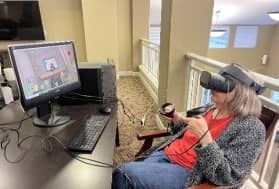
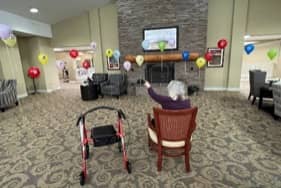
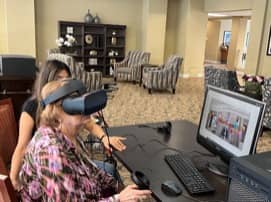
This research reports on the results of a within-subjects design conducted in a Virtual Reality (VR) environment to investigate the impact of different spatial patterns and color of light on the cognitive performance of older adults. Four experimental settings were created in the virtual reality version of an assisted living facility living room using two different correlated color temperatures (2700 k and 5000 k) and two spatial patterns of light (least stressful: non-uniform, peripheral, direct/indirect and most clear: uniform, central, direct)
This study builds upon a previous within-subjects experiment where the 32 participants completed a series of cognitive tasks in both real and virtual reality environments. In this study, the same 32 residents will complete a cognitive task and questionnaire in four different lighting conditions in VR.
Human-centric light is a new approach in lighting design, which focuses not only on the visual impact of light, but also on its non-visual aspects that influence circadian rhythms, sleep, mood, and cognitive performance. While an increasing body of knowledge exists on indoor lighting for older adults for improving their circadian rhythm, sleep quality, stress, mood, and behavior, there is a lack of integrated and consistent resources in the literature which investigate the role of lighting conditions on the cognitive performance of elderly people. Furthermore, these studies have mainly focused on some quantitative attributes of light such as light level and temporal pattern while other attributes of light such as spatial patterns of light and light spectrum have been neglected in these studies. Research suggests that a higher level of lighting, task lighting, and visual cues can increase clarity and contrast, reduce fall risk, and improve postural orientation and mobility. While previous studies have focused on the impact of light level and temporal pattern in human-centric lighting, the impact of light spectrum and spatial pattern has not been fully addressed. Thus, further studies are needed to establish more comprehensive human-centric lighting design guidelines in senior living facilities. The questions to be answered in this paper are: (1) Is there a difference in the subjective perception of older adults under different spatial patterns and correlated color temperature (CCT) of light? (2) Do spatial patterns and color of light impact the cognitive performance of older adults?